
Photonics West 2026
January 20-22, 2026 | Moscone Center | San Francisco, CA
Laser Diode Arrays
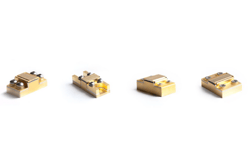
- 760 nm to 1700 nm
- CW or QCW operation
- Liquid or conductively cooled
- Peak optical power up to 1.5 kW per bar
- Compact, rugged, and modular
- Custom micro-optics for beam shaping and conditioning
- Line narrowing and wavelength locking
High-Repetition-Rate Advanced Petawatt Laser System (HAPLS)
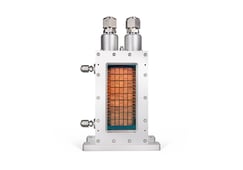
- Multiple peak wavelengths available from 800 nm to 1000 nm
- Built with monolithic, fully soldered arrays
- Cooling path isolated from the electrical path
- Non-water alternative cooling fluids
- Small bar-to-bar pitch for increased brightness
- Close-packed 2D arrangement
- Lowest bar-bar pitch available on the market
- Stackable micro-optics plates for beam conditioning and wavelength stabilization
Fiber Amplifier A40/L40
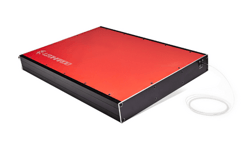
Leonardo’s fiber amplifiers are the core building blocks for fiber laser systems.
- Industrially and military rugged
- Configurations available for spectral or coherent beam combinations
- Low size and weight
- Long operating lifetime
- Integrated electronics and controls
- Easy-to-use interface
Target Illumination Laser Source (CW)
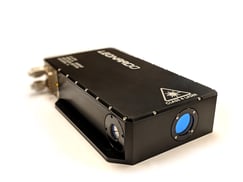
- SWIR CW Source
- Homogenized output beam
- Low size and weight
- Direct diode efficiency
Target Illumination Laser Source (Pulsed)
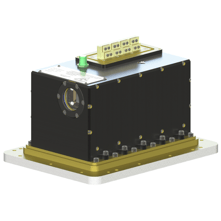
- High pulse energy
- Short pulse duration (microseconds)
- High repetition rate
- Homogenized output beam
- Low size and weight
- Direct diode efficiency
Homogenized Optical Pump Engine
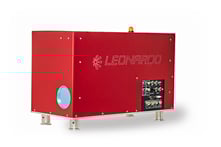
- High pulse energy
- Short pulse duration (microseconds)
- High repetition rate
- Homogenized output beam
- Low size and weight
- Direct diode efficiency
DLATGS - Infrared (IR) Spectrometers
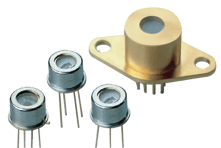
- DLATGS is one of the highest-performing commercial pyroelectric materials available today
- Doped with Deuterium to raise Curie temperature to ~ 59ºC
- Doped with L-alanine to prevent permanent depoling after excursions above Curie temperature
- Broad spectral response
- Standard detector supplied in a TO5 package
- Temperature stabilization is available in TO37 and TO66 type packages
IBEX 4M Array (2K X 2K, 15 Micron Pitch Array)
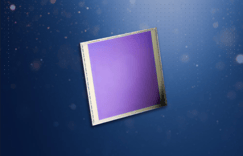
- 2048x2048 Format Array
- 4 Top + 4 Bottom Reference Rows
- 15um Pixel Pitch
- Low Glow Design
- Multiple windows. Both readout windows and reset windows are configurable
- 16, 8, and 4 analogue Video Outputs Selectable
- Output butter (or output source follower option)
- Non-destructive, Read-Rest-Read (RRR), interleaved, pixel by pixel and line by line reset
- Low Intrinsic noise
- Low Integration Capacitance
- Low Voltage Operation (3.3V)
Ike Pono
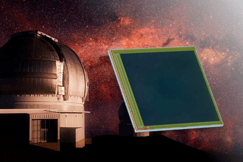
Ike Pono is a 1kx1k infrared detector aimed at ultra-low flux astronomical imaging. It provides avalanche gain at these very low photon-flux levels and, consequently, sets a new standard in sensitivity for astronomy. This not only allows for fainter objects to be observed, it allows shorter integration times for the same signal-to-noise thereby maximising the science return on large telescopes. Many future astronomy projects depend on photon-counting level sensitivity, including the imaging of faint objects and spectral lines.
Saphira - Avalanche Photodiode Array
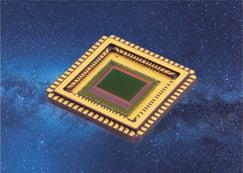
- Multiple independently resettable windows
- Selectable number of outputs up to 32
- Variable avalanche gain
- Voltage clamp function to minimise persistence
- Frame rate up to 200K frames per second with windowing
- Wavelength tuned to the application
- Windowing function to 1x32 pixels
SaphiraQM (512 x 512 ROIC)
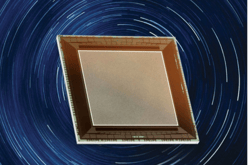
- Photon counting performance at maximum avalanche gain
- Very high frame rate
- Flexible integration and readout modes
- Multiple independently resettable windows (to 1x64)
- Wavelength tuned to application